Reference
The agent team in detail
Reference detail for the same five agents introduced earlier — each one's trigger, output, definition of done, and human checkpoint.
The moving parts are open: inspectable prompts in the plugin folders,
runtime wiring in the agent architecture docs,
and container setup in the Docker deployment guide.
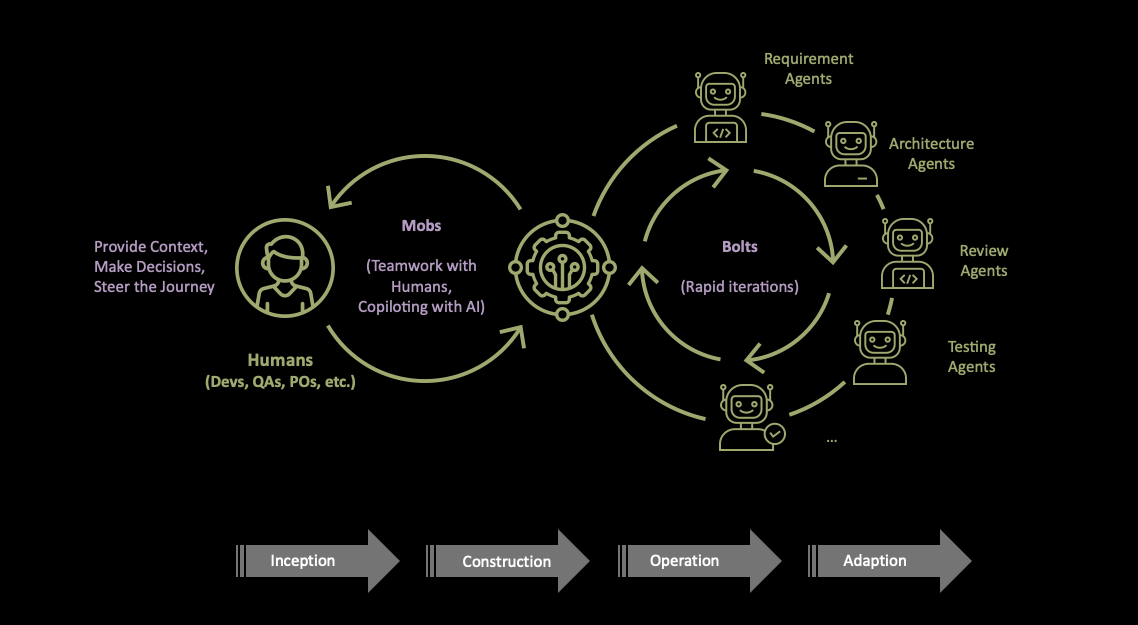
These agents are loosely coupled in implementation, but they operate as a team by passing artifacts forward and stopping at human checkpoints. One agent's output becomes the next agent's input, and people can approve, edit, or redirect the handoff at each stage.
Requirement Analyst
Groomed backlog item
→
Technical Designer
Technical design spec
→
PR Reviewer
Categorized findings
→
Test Planner
Prioritized test plan
→
Release Manager
Release-ready draft
Shared artifacts, not tight runtime coupling, are what make this a team: backlog context flows into design, design and implementation flow into review, review feeds testing, and approved change signals feed release preparation.
Trigger: A new backlog item (story, task, bug) is created.
Clarifies backlog items into structured requirements with acceptance criteria, edge cases, and targeted questions.
Show details
Trigger
A new backlog item (story, task, bug) is created.
- Cross-references the item against existing product, architecture, and related stories
- Expands terse descriptions into structured requirements with acceptance criteria and edge cases
- Flags ambiguities, contradictions, and under-specified criteria
- Sends targeted questions to the item creator instead of generic requests for clarification
- Iteratively refines until the item meets a defined "groomed" threshold
Output
A clarified backlog item with structured acceptance criteria, identified risks, and resolved open questions
Done when
The item has clear acceptance criteria, key edge cases, explicit open questions or assumptions, and is ready for planning without another round of generic clarification
Human touchpoint
Product owner reviews the elaborated item and decides when it's ready for sprint planning
Trigger: A groomed backlog item is moved into a sprint or assigned to a developer.
Turns a ready item into an implementation spec with affected components, interfaces, and testing expectations.
Show details
Trigger
A groomed backlog item is moved into a sprint or assigned to a developer.
- Reviews requirements against the current system architecture, code structure, and conventions
- Produces a technical design doc: affected components, data model changes, API contracts, integration points
- Enforces established patterns (layering, dependency direction, naming) and flags deviations
- Provides implementation guidance: which files to modify, what interfaces to implement, what tests to write
Output
Technical design spec aligned with the architecture, ready for a developer to pick up
Done when
A developer can start implementation with affected components, interfaces, constraints, and expected tests called out, with major trade-offs surfaced for review
Human touchpoint
Developer (and optionally a senior engineer) reviews the design; they own the final approach
Trigger: A pull request is created or updated.
Checks the change against requirements, architecture, code quality, and risk before human sign-off.
Show details
Trigger
A pull request is created or updated.
- Verifies implementation satisfies acceptance criteria from the original requirements
- Checks adherence to architecture: layering rules, dependency direction, naming conventions
- Evaluates readability, complexity, error handling, and coding standards
- Flags high-risk changes (security-sensitive code, data migrations, public API changes)
- Posts structured review comments with clear pass/fail per check and actionable recommendations
Output
PR review with categorized findings (architecture, functional, quality, risk) as comments or status checks
Done when
The PR has been checked against requirements and standards, findings are categorized by severity, and any blocking risks are explicit enough for the author to act on
Human touchpoint
Developer addresses feedback; human reviewer does final sign-off, especially for high-risk changes
Trigger: A pull request is created or updated and has passed initial automated checks or received PR Reviewer feedback.
Prioritizes the highest-risk test scenarios and highlights gaps in automated coverage before merge.
Show details
Trigger
A pull request is created or updated and has passed initial automated checks or received PR Reviewer feedback.
- Identifies highest-risk areas that need manual testing - focuses effort where it matters most
- Maps existing functionality that could regress and recommends targeted regression tests
- Produces concrete, executable test scenarios: happy paths, edge cases, error conditions, integration boundaries
- Compares change scope against existing automated test coverage and highlights gaps
Output
Prioritized manual test cases for highest-risk areas, plus recommendations for new automated tests
Done when
The highest-risk scenarios are prioritized, likely regressions are mapped, and test gaps are visible early enough to influence the PR before merge
Human touchpoint
QA engineers execute the test cases and apply judgment about additional exploratory testing
Trigger: Approved changes are ready to be prepared for release.
Prepares release-ready notes and readiness signals, while calling out breaking changes and rollout concerns.
Show details
Trigger
Approved changes are ready to be prepared for release.
- Compiles release notes from merged PRs and groups them into useful categories
- Checks release readiness across completed work, outstanding blockers, and known risks
- Flags breaking changes and highlights rollout concerns that need explicit review
Output
Draft release notes, readiness checks, and a categorized changelog for human approval
Done when
Release notes are draftable from the change set, breaking changes and rollout risks are called out, and the release owner has enough context to approve timing and communication
Human touchpoint
A release owner reviews the draft, confirms timing, and approves the final release communication